 Products







Ready to get started?
No matter where you are on your CMS journey, we're here to help. Want more info or to see Glide Publishing Platform in action? We got you.
Book a demoWhen gaming site Altchar redesigned its site, it was an opportunity to upgrade its delivery infrastructure at the same time. This is where the new front-end and Glide Deliver V3 came together, and we describe what the results mean for any publisher running on older delivery infrastructure.
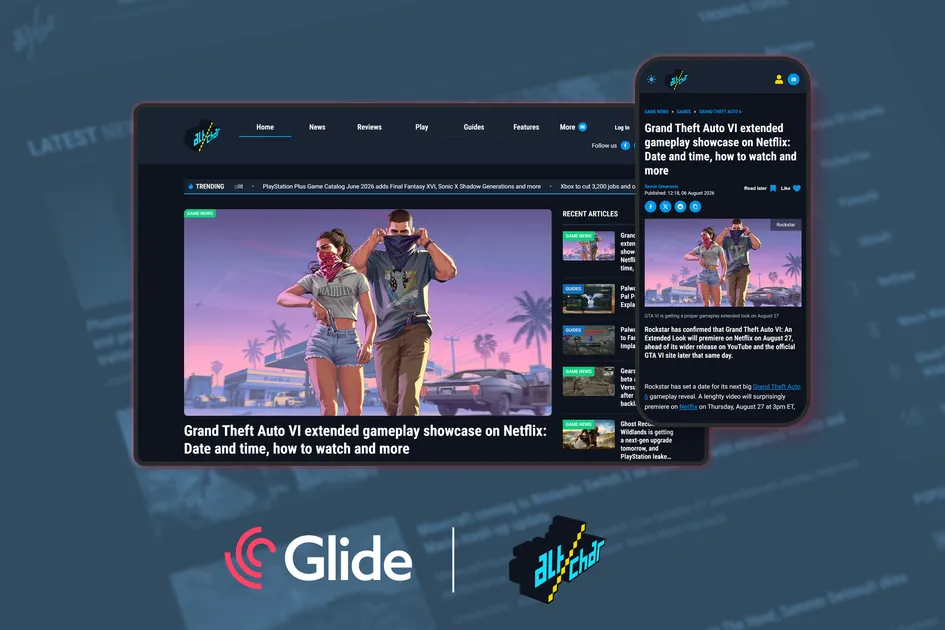
When games site AltChar decided it was time for a new look, the question went further than design. The site is an independent gaming publication covering news, reviews, guides, and features across PC, PlayStation, Xbox, and Nintendo. Attracting around 200,000 monthly visitors, AltChar is run by a small international editorial team with no appetite for infrastructure that demands constant attention.
AltChar is owned by Glide Publishing Platform. We run it on the same platform we offer customers. That means the performance figures and development experience described here aren't from a controlled demo or a proof-of-concept. The figures come from a real editorial team publishing content to a real audience daily. When we ship improvements to Deliver, AltChar is where we prove they work.
AltChar had been running on Deliver V1 since launch. A front-end redesign was the natural trigger to ask a bigger question: should the delivery infrastructure underneath it move forward at the same time? It did both. The result is a site that looks different and performs differently, and the two things are more connected than they might appear.
Glide CMS is headless, which means customers can use whatever front-end framework they choose. Glide Deliver is the option we provide for teams that don't want to architect their own delivery infrastructure from scratch. It's a delivery stack we build and maintain - CDN, caching, serverless compute, and security on AWS - available to all Glide customers at no additional cost, with a developer CLI, pre-built platform packages, and infrastructure defined in code. Teams that want to move fast can use it; teams with existing frameworks don't have to. V3 is the current version, rebuilt from the ground up.

AltChar homepage before the redesign and Deliver V3 upgrade
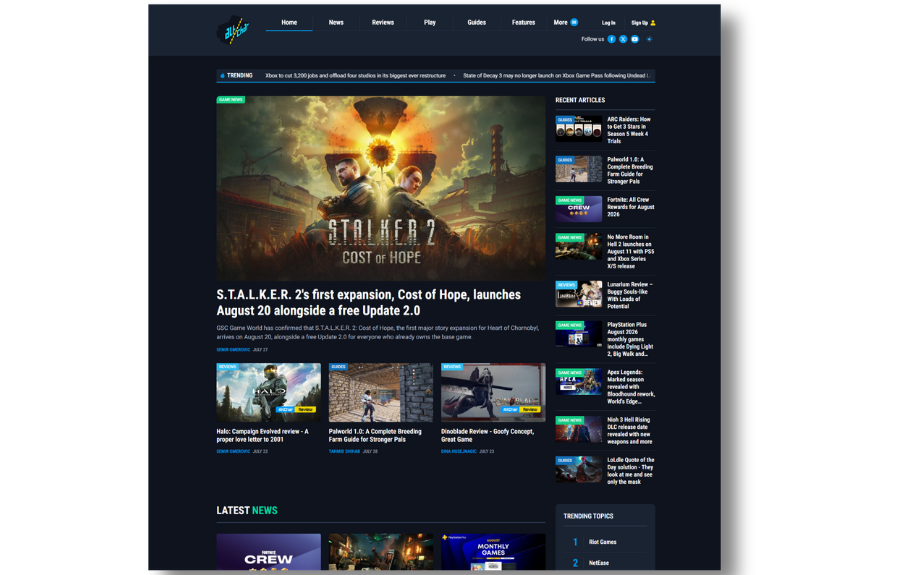
The current AltChar homepage, site running on Deliver V3
Navigation, layout, article pages, mobile experience: everything readers interact with was reconsidered from scratch, with new themes and a structure built to feel current rather than updated.
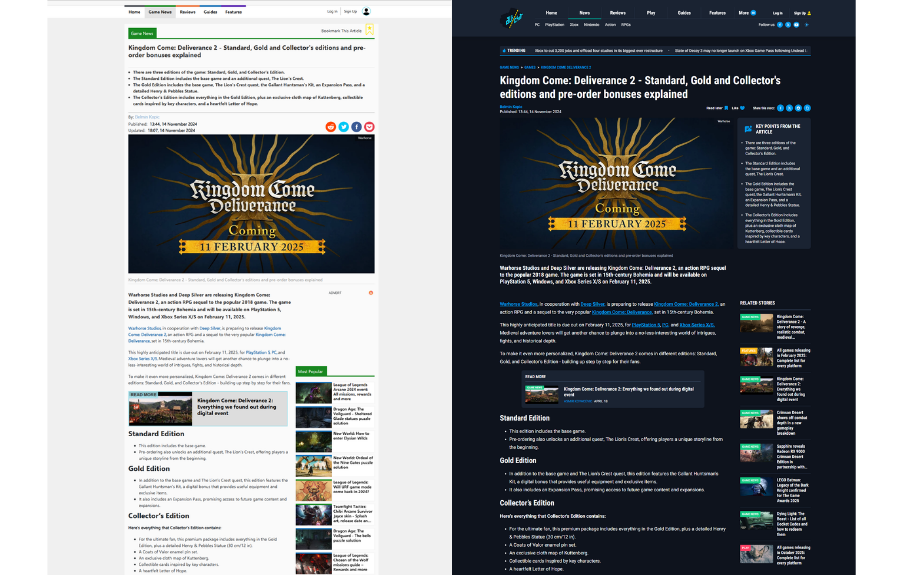
AltChar redesign: before and after shots of the article page
"The old site had served us well, but it was starting to show its age. Compared to where the rest of the industry had moved, it felt dated, both visually and in terms of what readers expect from a modern content experience. We wanted to redesign everything from the ground up with new themes, a cleaner layout, and a look that actually reflects the quality of the content we publish. But we also knew that a better-looking site that still felt slow would defeat the point. Upgrading to Deliver V3 at the same time meant we could tackle both together, and the results have been exactly what we were hoping for." - Semir Omerović, Editor, AltChar
Most independent publishers manage caching, CDN, and security layers as separate concerns, either stitched together manually or spread across multiple services.
Unlike V2, which introduced incremental improvements, V3 is a ground-up rebuild that changed how pages are constructed, served, and scaled.
Older delivery infrastructure served pages from a single origin and shipped the full JavaScript bundle to every browser regardless of what a given page needed. V3 uses React Server Components to send only the code a given page requires to reduce the client-side bundle, and streams content progressively so readers see something useful - headline, navigation, and above-the-fold layout - well before the full page has loaded.
Pages are served via AWS CloudFront from edge locations geographically close to the reader, which matters because Google measures real-user experience by region. A site that's fast in London but slow in North America or Southeast Asia will reflect that in its search rankings, and most publishers are serving global audiences. AWS WAF sits at the same layer, filtering bot traffic and DDoS attempts before they reach the application. Performance stays stable when traffic spikes.
Application logic runs serverless on AWS Lambda using ARM64 processors. V1 required provisioned capacity: you paid for servers whether they were handling traffic or not, and spikes could still overwhelm the setup. V3 scales automatically to match actual demand and costs nothing when traffic is quiet. AltChar's server response time in production is 6ms, pure server speed before network latency, and pages load in under two seconds for real users globally. A Valkey cache layer between the application and the CMS API returns already-fetched content in sub-milliseconds, so most readers never wait for an API call. When an editor publishes, the cache invalidates automatically and updated content reaches readers within seconds.
The whole stack is defined in Terraform, so every environment from development to production is identical, rollbacks are straightforward, and the infrastructure is fully auditable. This makes deployments predictable and incidents much easier to diagnose.
"With V3 we wanted to give publishers a delivery layer that simply gets out of the way. One which is fast by default and globally consistent, and can handle traffic spikes without operational overhead. AltChar's results are a good illustration of what that looks like in practice." - Dženita Vejsilović, Head of Content Engineering, Glide Publishing Platform
Deliver V3 offers two deployment models depending on traffic profile and cost performance. Serverless Lambda scales automatically and charges only for actual usage, which suits variable or unpredictable traffic. EC2 provides reserved capacity at predictable fixed costs, which suits consistently high-volume sites. Both run on the same CDN, WAF, and caching infrastructure and deliver the same performance outcomes.
AltChar chose serverless because of the variability in gaming news traffic, spiking around major releases and events and relatively low during quiet periods.
The figures below compare Lighthouse scores before the migration, immediately after deployment on February 23, 2026, and as of June 19, 2026, measured via PageSpeed Insights.
Homepage
| Metric | Before (Feb 19) | After (Feb 23) | After (Jun 19) | |
|---|---|---|---|---|
| Mobile Performance | 78 | 98 | 90 | |
| Desktop Performance | 97 | 100 | 98 | |
| Accessibility (mobile) | 95 | 96 | 96 | |
| Best Practices | 100 | 100 | 100 | |
| SEO | 100 | 100 | 100 |
Article Page
| Metric | Before (Feb 19) | After (Feb 23) | After (Jun 19) | |
|---|---|---|---|---|
| Mobile Performance | 86 | 88 | 88 | |
| Desktop Performance | 93 | 100 | 87 | |
| Mobile SEO | 85 | 100 | 100 | |
| Mobile Best Practices | 96 | 100 | 96 | |
| Mobile Accessibility | 88 | 94 | 96 | |
| Desktop Best Practices | 100 | 100 | 100 |
The homepage mobile performance score moving from 78 to 98 on deployment is the standout. On article pages, SEO went from 85 to 100 on both mobile and desktop, a large and lasting gain for a site relying on organic search.
A note on the June figures:
The desktop performance score on article pages dropped from 100 at deployment to 87 by June. This is a familiar pattern in publishing: third-party scripts added after deployment gradually increase main-thread work. The delivery infrastructure itself remains performant; the drop reflects client-side tag accumulation that the editorial and ad ops teams can address independently.
These figures reflect what real users experienced across the 28 days to May 2026, via Google's Chrome UX Report. Unlike the Lighthouse scores above, which are lab-based, CrUX captures real device and network conditions across all Chrome users visiting the site. CrUX measures TTFB from the user's browser, including DNS resolution, connection setup, and network round-trip. The 6ms server processing time confirms the infrastructure is fast; the remaining latency reflects real-world user network conditions rather than infrastructure performance.
| Metric | Score | Google threshold |
|---|---|---|
| LCP - Largest Contentful Paint | 1.6s | < 2.5s |
| INP - Interaction to Next Paint | 70ms | < 200ms |
| CLS - Cumulative Layout Shift | 0.1 | < 0.1 |
| FCP - First Contentful Paint | 1.4s | < 1.8s |
| TTFB - Time to First Byte | 1s | < 0.8s |
All three Core Web Vitals (LCP, INP, CLS) pass.
TTFB is the one metric that currently exceeds Google’s recommended threshold, however this most likely reflects users in regions distant from the nearest CloudFront edge location pulling the average up.
Sites that pass Google's Core Web Vitals thresholds receive a ranking signal in search that compounds over time. Faster load times reduce drop-off, so a responsive interaction layer removes friction from the moments that drive subscription and ad revenue.
Lighthouse SEO scores improved from 85 to 100 on article pages, but synthetic scores are only one measure. The real question for any publisher is whether infrastructure improvements translate to organic traffic growth.
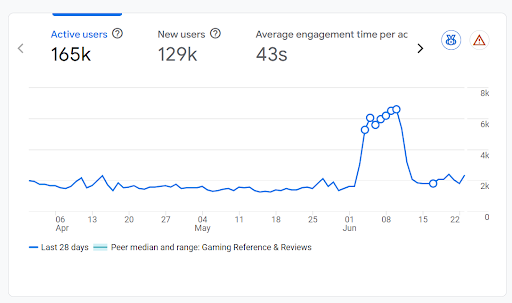
AltChar users: April 1 - June 23 2025
The structural improvements that support SEO gains include: faster page load reducing crawl timeout rates, clean URL structures and server-side rendering ensuring all content is indexable on first request, and progressive streaming meaning Googlebot receives complete page content without waiting for client-side JavaScript execution.
Gaming traffic is release-dependent: a site covering PC and console titles will see material swings based on what ships in a given month, which makes clean year-on-year comparisons difficult.
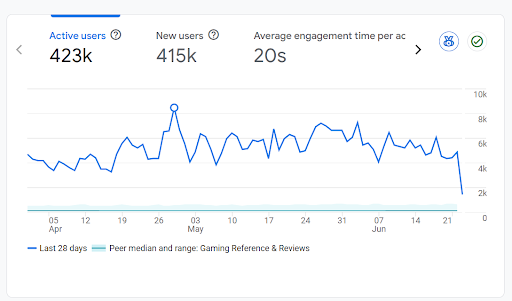
AltChar users: April 1 - June 23 2026
The same April-to-June window compared: 2025 (pre-migration) saw 165k active users; 2026 (post-migration) saw 423k, a growth figure of 156%. The 2025 window included three of the biggest releases of that year: Monster Hunter Wilds in late February, Assassin's Creed Shadows in March, and Elden Ring Nightreign in late May, all of which drove sustained guide and review traffic. The 2026 window had Resident Evil Requiem and Crimson Desert earlier in the period, both strong releases but not at the same scale for AltChar, and a quieter April and May by comparison. A weaker release calendar produced 2.5x the active users.
The infrastructure gains show up in individual editorial moments too. When Rockstar announced GTA 6 pre-orders in June 2026, AltChar appeared in Google's Top Stories carousel - the only independent publisher featured alongside Rockstar's own newswire. Top Stories prioritises pages that are fast to crawl and render, with Core Web Vitals already passing. Without the delivery performance underneath, editorial speed alone wouldn't have got it there.
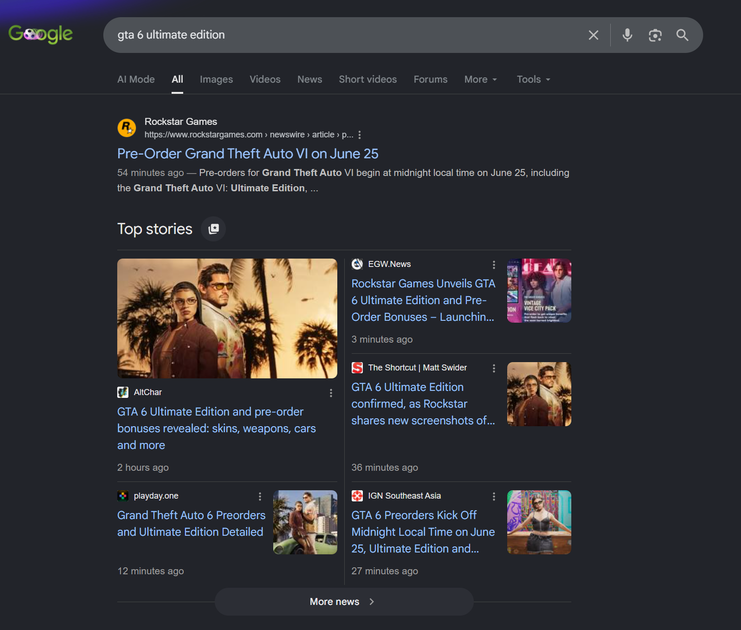
AltChar in Google's Top Stories for GTA 6 Ultimate Edition, June 2026
Running a full front-end redesign and an infrastructure upgrade in parallel could easily become two competing workstreams. With Deliver V3, it didn't, because the delivery infrastructure was ready from day one rather than something the team had to build alongside the redesign. The CLI scaffolds a new project with a single command, with pre-built platform packages covering CMS data fetching, page rendering, route resolution, and cache invalidation, plus Storybook integration and monorepo support.
The V3 developer toolchain also includes steering files for AI-assisted development, which handle roughly half of common tasks automatically. This means that common implementation tasks - e.g. creating new page templates, wiring up taxonomy routes, building content list components - can be completed with AI assistance rather than from memory or documentation alone.
AltChar paired the V3 migration with a site redesign, but the two aren't coupled. Publishers running on earlier Deliver versions, or on their own delivery infrastructure, can upgrade without it being tied to a broader rebuild.
If you want to understand what Deliver V3 would mean for your platform, speak to a Glide specialist.
Related reading
Performance data: PageSpeed Insights, Google CrUX (28-day rolling average, real users) - February, May, and June 2026. AltChar migrated from Deliver V1 to Deliver V3.
No matter where you are on your CMS journey, we're here to help. Want more info or to see Glide Publishing Platform in action? We got you.
Book a demo
